esea contemporary marks its 40th anniversary in 2026 with Thresholds of Becoming, a new group exhibition bringing together six artists whose practices probe the architectures of transition and the fragile ecologies of the in-between: Nicole Coson, Xin Liu, Charmaine Poh, Minoru Nomata, Yang Yongliang, and Yin Aiwen.
Curated by esea contemporary Director, Xiaowen Zhu, the exhibition understands transformation as a restless process of reconfiguration — of meaning, of material, of the bonds that hold us together and the fractures that pull us apart. The exhibition positions mutation and instability not as failures, but as generative states through which new worlds might be glimpsed.
Drawing on Vietnamese theorist Trinh T. Minh-ha’s writing on passage and in-betweenness — that to move across is also to move within — the exhibition dwells in these thresholds — tidal, digital, speculative, terrestrial — tracing the fragile grounds on which we live. Here, transition becomes a lived condition: a turbulence in which forms reorganise, histories unsettle, and futures flicker into view.




Through Some place, within here (2024), Nicole Coson extends her enquiry into surface, memory and material translation. A suspended constellation of aluminium-cast oyster shells linked by metal rings, drawing from aquafarming structures in the Philippines — where oysters grow on latticed grids beneath shifting currents — registers subtle ecological and temporal drift. This architecture of cultivation becomes a threshold in which vernacular forms shift registers, revealing how materials gather histories as they move, settle and transform across contexts.
In Insomnia (2025), Xin Liu brings biology, engineering and speculative research into convergence within a self-contained micro-ecosystem. A rectangular steel tank grows a green, moss-like aquatic plant called duckweed, a fast-replicating invasive species that floats on the surface of slow-moving bodies of water. Two horizontal towers stand beside the tank, raining down a thick viscous liquid in continuous thread-like streams. Duckweed is often a problem in ponds and nature parks by forming dense mats on the water’s surface, blocking sunlight, reducing oxygen levels, and thriving at the expense of other forms of life. However, recent scientific studies have identified it as a potential candidate for the future of organic fuel and food production in outer space. Liu’s ecosystem balances this tension: the cost of overproduction and the possibility of discovery and renewal.
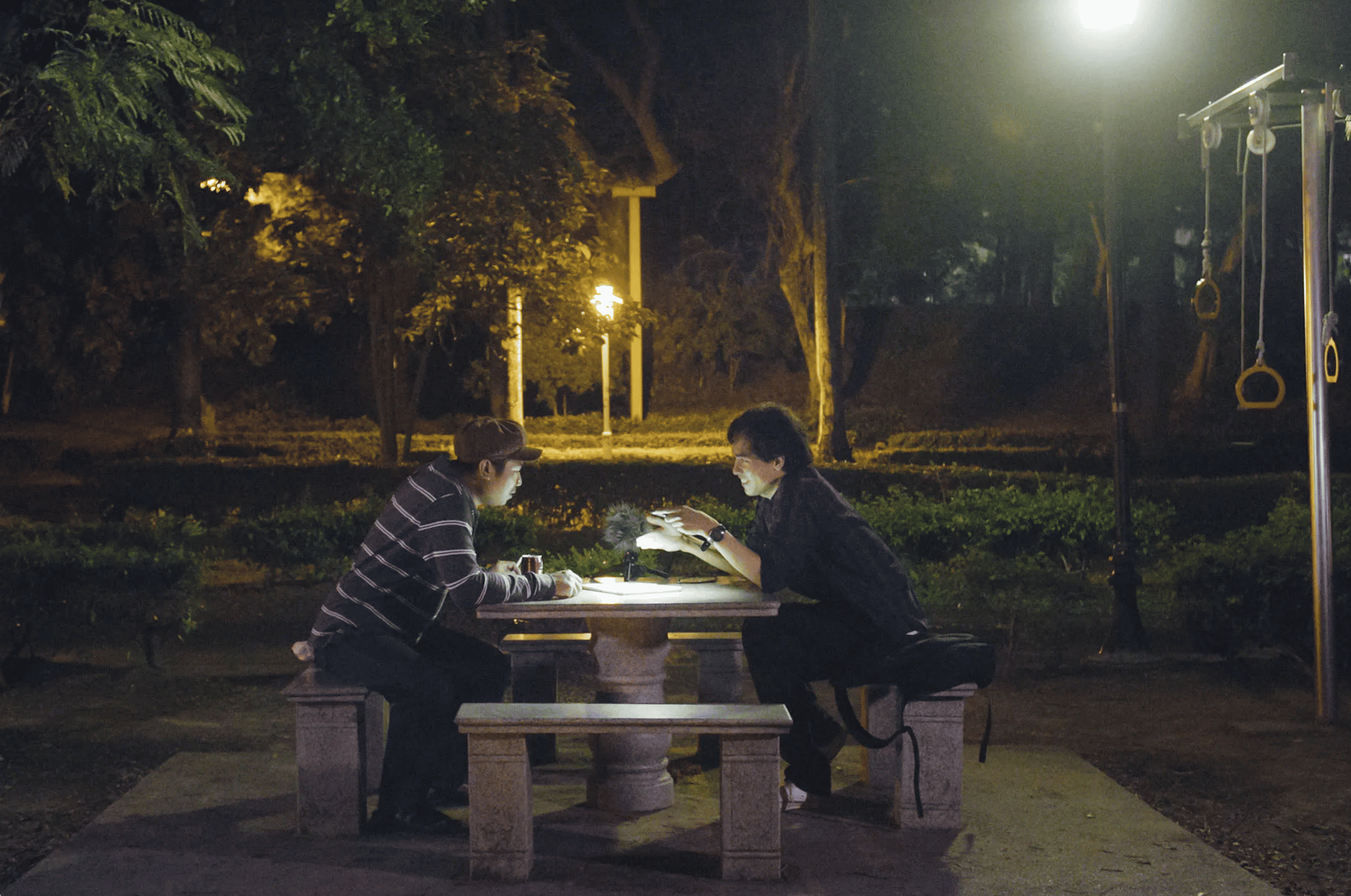
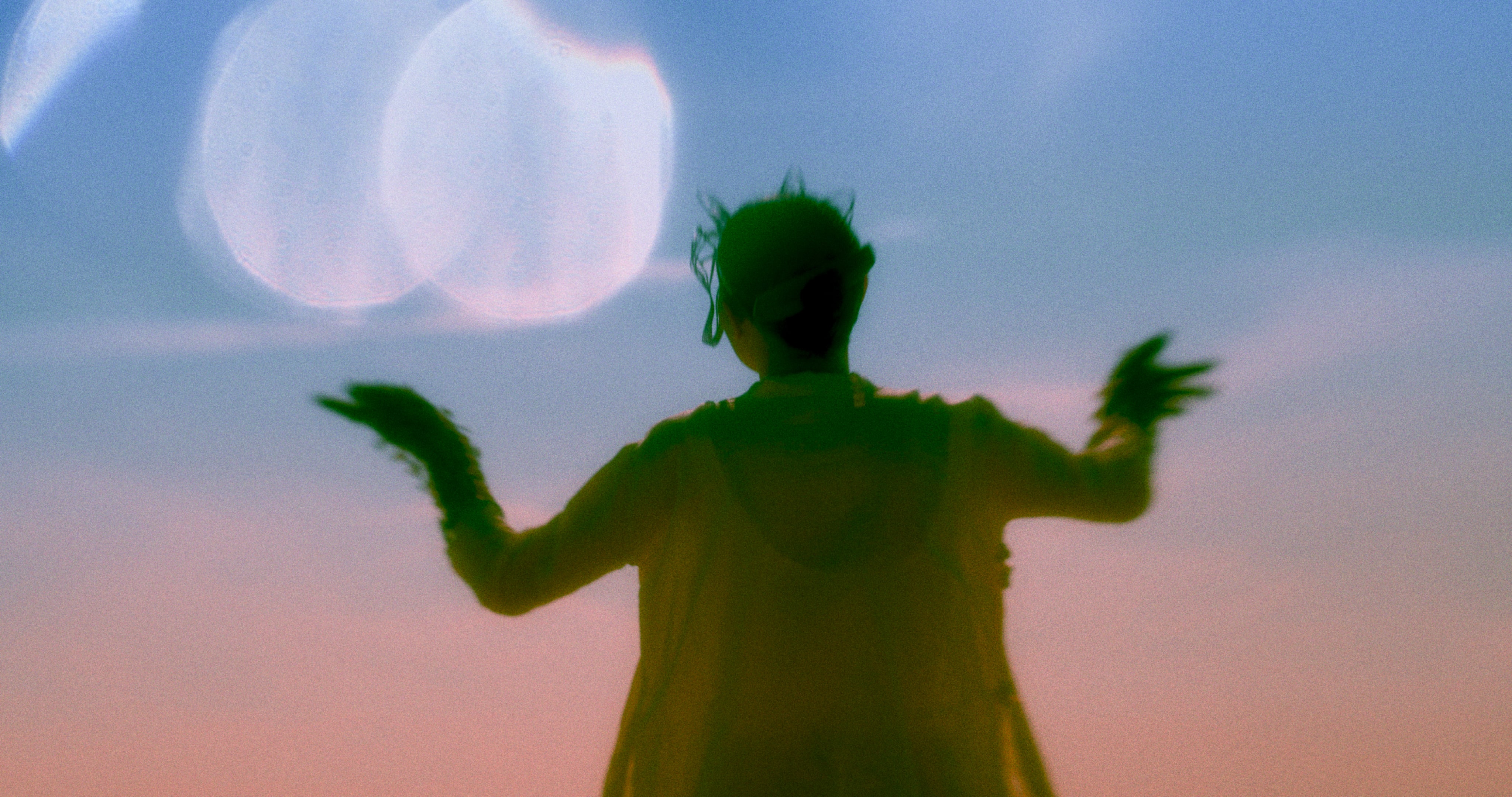
Charmaine Poh deepens her exploration of memory, ritual and queer longing in The Moon Is Wet (2025), a multi-channel installation that entwines personal testimony with the shifting ecologies of contemporary Singapore. Working across film, photography and performance, Poh treats identity as both embodied archive and enacted fiction. Three video channels form an immersive environment where narratives—drawing on Majie domestic workers, queer Southeast Asian caregivers and the sea goddess Mazu—ebb like tidal currents. Moving between mangrove zones, water-dependent data centres, reclaimed coastlines and the financial district, the installation traces tensions between survival, desire and infrastructural power. The Moon Is Wet meditates on intertidal existence, where submerged histories surface and acts of care—human and more-than-human—open onto provisional futures shaped by displacement and longing.
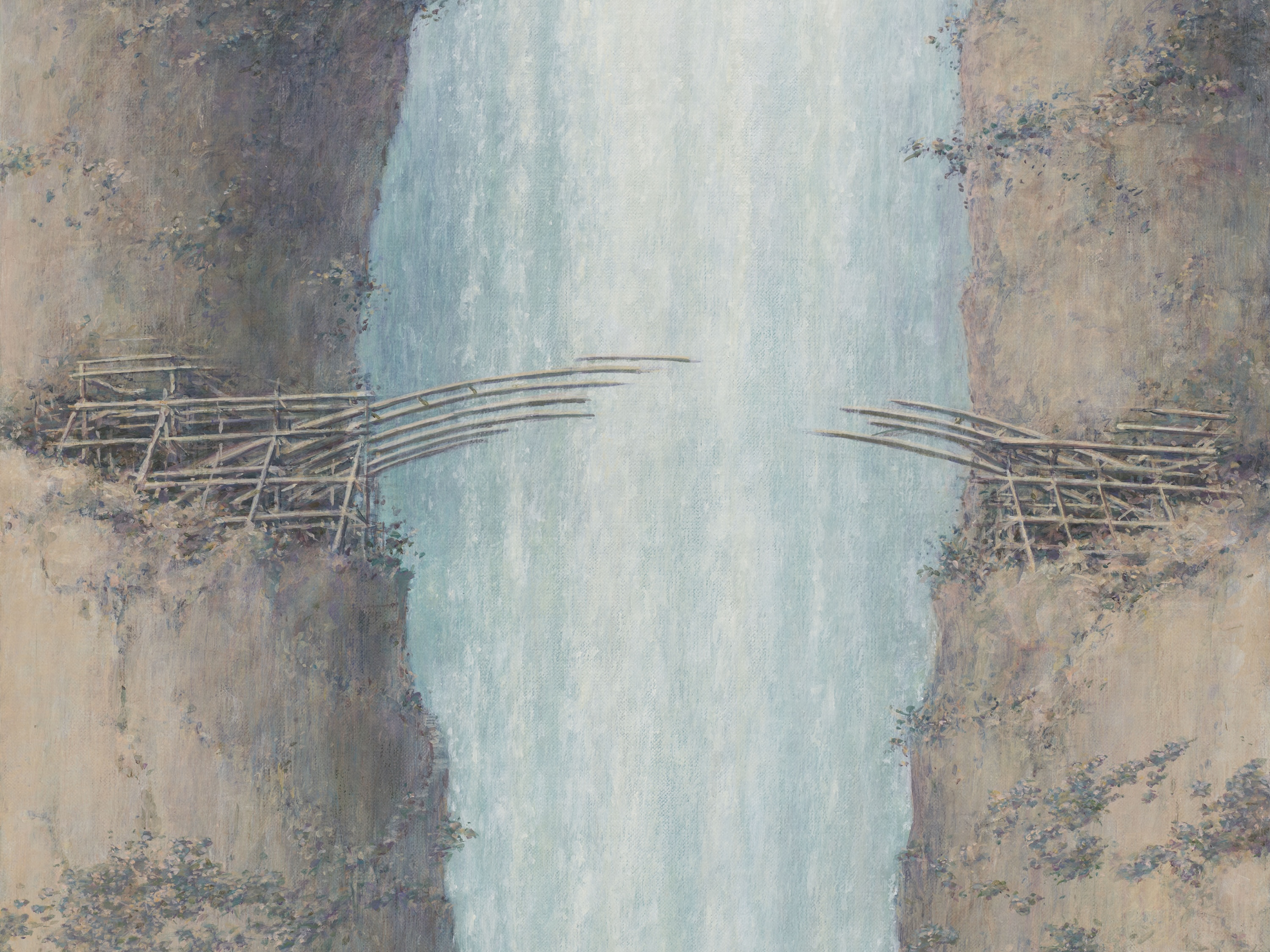
In Resonance–1 and Resonance–2 (2025), Minoru Nomata presents solitary architectures and natural forms rendered in crisp, otherworldly clarity. The works shift between psychological interiority and environmental precarity: one oriented toward speculative verticality, the other toward a landscape marked by collapse, erosion, and the fragile remains of structure. Together, they bind uplift and aftermath into a single horizon, extending Nomata’s meditation on architectures shaped by vulnerability and uncertain futures.
In Mountains of Crowds (2016), Yang Yongliang reconfigures classical shanshui (山水) through intricate digital montage. His panoramas unfold in slow, cinematic rhythms: mountains emerge as latticed skylines, and ink-like washes dissolve into grids of light. Here, history and hypermodernity merge into terrains that are both haunted and re-coded, mapping the unstable architectures that shape contemporary life.
For Thresholds of Becoming, Yin Aiwen presents a newly localised iteration of Liquid Dependencies: what does a decentralised caring society look like? (2021–ongoing, developed with Zoe Zhao and Yiren Zhao, UK iteration assisted by Lauren Rees and Yee Ting Lau). This Live Action role-playing experience invites ten participants to inhabit characters who form interdependent relationships across simulated decades. Liquid Dependencies sets a participatory frame, whilst its evolving scenarios function less as metaphor than as rehearsal: a space to test the infrastructural conditions under which care, obligation and interdependence might be organised in the future.
Taken together, the works in Thresholds of Becoming frame transformation as a condition both intimate and planetary — enacted through bodies, materials, infrastructures, and imagined futures. Each artist offers a distinct vocabulary for navigating the unstable architectures of the present, where collapse and renewal coexist. Collectively, the exhibition asks: What becomes possible when transformation is approached not as crisis but as a structural condition of the present? How might emergent relations, infrastructures, and imaginaries assemble themselves within — and because of — the unstable terrains we inhabit?
The exhibition has received generous support from Arts Council England, Greater Manchester Combined Authority, University of Salford Art Collection, Public Gallery, White Cube, Silverlens, Palais Populaire, Octone Art Foundation, Bryan and Dinggay Villanueva, and all participating artists.
Nicole Coson (b. 1992, Manila) is a Filipino artist based in London. Working across printmaking and sculpture, Coson examines how images mediate memory, history and material culture. She translates symbolic, often vernacular objects into negative impressions via the etching press, producing canvases that oscillate between pattern, surface and depth. Embracing opacity as an aesthetic and political strategy, her work resists fixed readings of identity, foregrounding the critical potential of visual obfuscation. Through these shifting thresholds of visibility, Coson reflects on looking, legibility and the intimate architectures of what remains partially concealed.
Xin Liu (b. Xinjiang) is a London-based artist and engineer. Liu’s practice explores the entropic afterlives of scientific and technological aspiration, tracing the debris, exhaust and metabolic transformations that shape infrastructures of progress. Working across sculpture, moving images and research-led installation, she investigates cryogenic vessels, dissolving plastics, falling rocket fragments and self-monitoring satellites—phenomena she frames as Cosmic Metabolism. Her institutional solo exhibitions include Seedlings and Offspring at Pioneer Works, New York, and At the End of Everything at Artpace, San Antonio. She has been commissioned by institutions including Hyundai Art Lab, Moody Center for the Arts, Artnet, BMW Culture Group, and M+ Museum. Her work has been exhibited at the Shanghai Biennale, Thailand Biennale, MAXXI in Rome, MoMA PS1, the Museum of Fine Arts Boston, the Hammer Museum, among others. Forthcoming projects include a solo exhibition at Fondazione Sandretto Re Rebaudengo, Turin, Italy, curated by Hans Ulrich Obrist.
Charmaine Poh (b. 1990, Singapore) is an artist working between Berlin and Singapore. Through film, photography, performance and media, Poh examines visibility, care and queer embodiment across Asian contexts. Her work considers how identities are formed, negotiated or withheld, engaging opacity, futurity and practices of repair. Recent projects explore kinship, intergenerational memory and the entanglements of nature, technology and the body, often combining documentary techniques with staged gestures and speculative imagery. A co-founder of the independent magazine Jom and member of the Asian Feminist Studio for Art and Research, Poh was named Deutsche Bank’s Artist of the Year 2025 and participated in the 60th Venice Art Biennale.
Minoru Nomata (b. 1955, Tokyo) is a painter based in Tokyo. Nomata studied design at the Tokyo University of the Arts, graduating in 1979 before taking up a position in an advertising agency in Tokyo. After five years Nomata left in order to focus on his painting practice, and in 1986 held his debut exhibition ‘STILL – Quiet Garden’ at the Sagacho Exhibit Space, an alternative gallery in Tokyo run by Kazuko Koike. Further solo exhibitions include Meguro Museum of Art, Tokyo (1993); Tokyo Opera City Art Gallery (2004); The Museum of Modern Art, Gunma, Japan (2010); Sagacho Archives, Tokyo (2012, 2018), De La Warr Pavilion, Bexhill-on-Sea (2022) and most recently at Tokyo Opera City Art Gallery (2023). Until recently, Nomata was a Professor at the Joshibi University of Art and Design in Tokyo.
Yang Yongliang (b. 1980, Shanghai) is a New York–based artist. Trained in classical Chinese painting, Yang reconfigures shanshui traditions through dense digital montage. His panoramic compositions initially resemble ink landscapes, yet dissolve on close viewing into skyscrapers, circuitry, construction grids and urban sprawl. This tension between beauty and disquiet articulates the contradictions of hypermodernity: its acceleration, artificiality and uneasy continuities with the past. Working across photography, moving image and installation, Yang builds atmospheres that question how contemporary civilisation reshapes cultural and ecological terrain. His work is held in major public collections worldwide.
Yin Aiwen (b. Zhanjiang) is a Rotterdam-based designer, artist, researcher and strategist. Yin is an artist, designer, researcher, and occasional institutional strategist. Departing from the idea that 'the technological is institutional, the institutional is technological', Yin reconsiders and reimagines socio-economic, cultural, emotional, and bodily conditions by designing new techno-institutional frameworks grounded in care ethics. Her work often begins with ambitious speculative questions and uses critical theory as a design brief to create new systems of value through various forms of demonstration, such as performances, games, digital platforms, or exhibitions. Yin teaches at Design Academy Eindhoven and the Master Institute of Visual Cultures in the Netherlands. She received an Asymmetry Scholarship to pursue a PhD in Advanced Practices at Goldsmiths, University of London in 2024. Previously, she held research fellowships at Framer Framed (2024), the Creative Impact Research Centre Europe (2024 & 2023), ZK/U Berlin (2019), and Art Center South Florida (US, 2017). In 2019, Yin received the INFORM Prize for Conceptual Design for her work.
‘From our beginnings as a grassroots Chinese Visual Arts Festival to our evolution into an artist-run space and later a National Portfolio Organisation, our history reflects continual transformation. Our revisioning in 2022 and reopening in 2023 reaffirmed our commitment to supporting artists of East and Southeast Asian heritage while imagining new forms of cultural work. This exhibition gathers practitioners who embrace instability as a generative force, inviting us to consider how relationships, uncertainties and acts of care might guide the futures we create together.’
— Xiaowen Zhu, Director, esea contemporary

%20Courtesy%20of%20the%20artist%2C%20Makeroom%20LA%2C%20Public%20Gallery%2C%20London.jpg)