How to Touch the Elephant
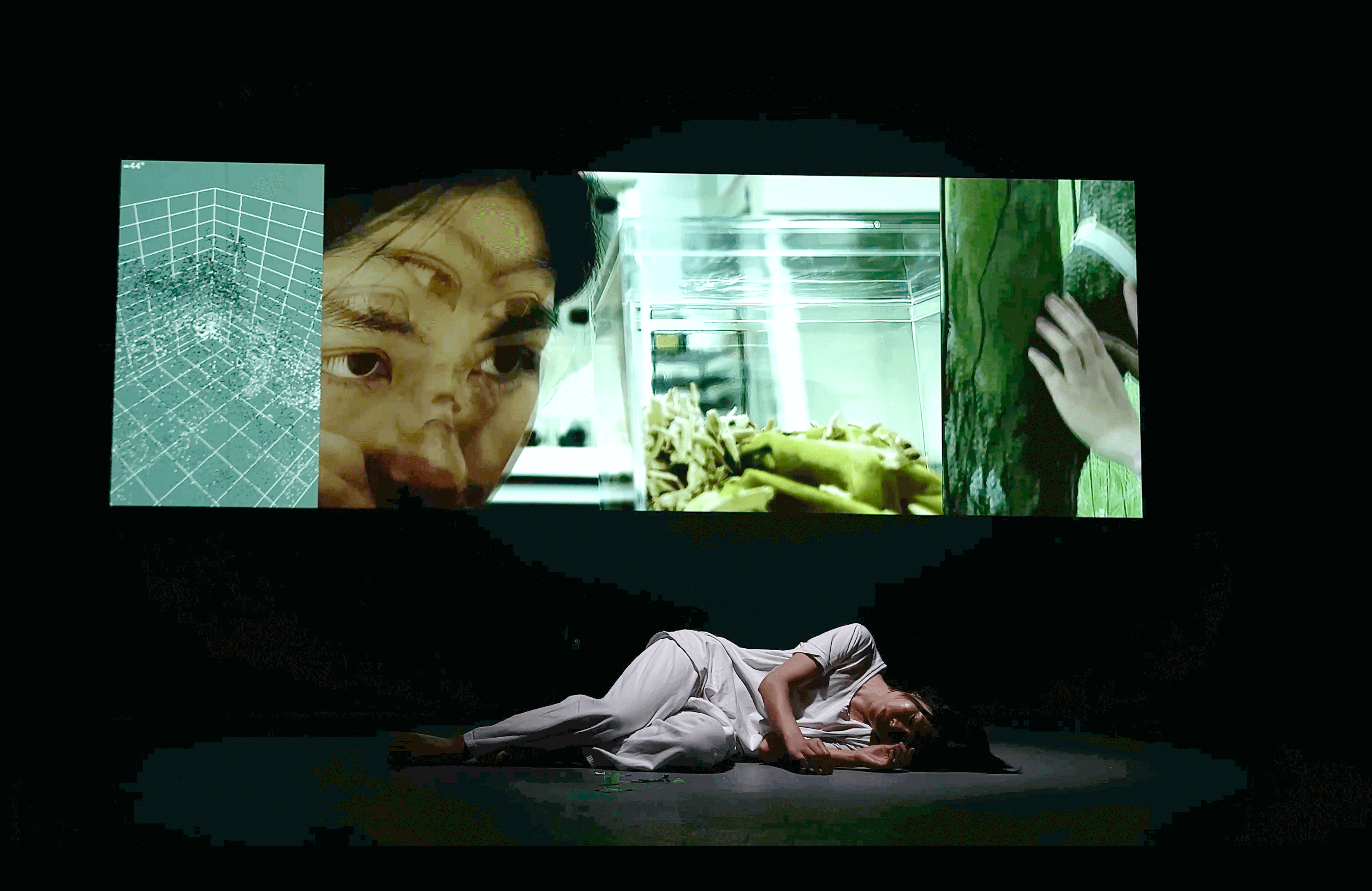
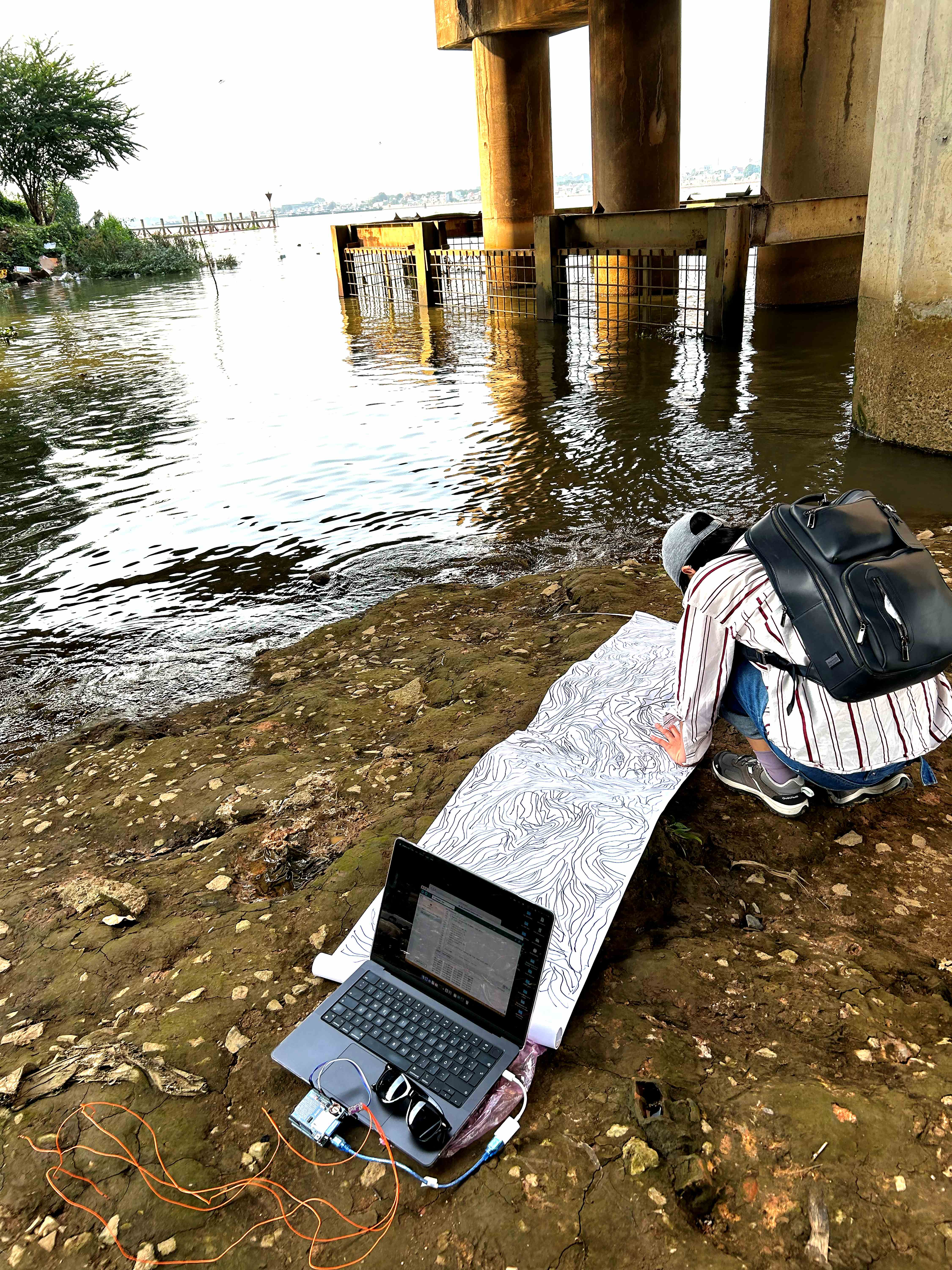
Beginning with her father’s memory of carrying bomb fragments in his chest since the Vietnam War, Hiền Hoàng’s How to Touch the Elephant traces the enduring effects of war across human bodies and post-Agent Orange landscapes in Vietnam. Through soil measurement, on-site drawing, material research and data sonification, Hoàng explores how the landscape records histories of violence and how these histories might be sensed, measured and made visible beyond conventional forms of documentation.
In this conversation with Xiaowen Zhu, Hoàng reflects on the relationship between inherited trauma and ecological memory, and on the limits of legal systems in addressing the ongoing consequences of toxic warfare. Moving between family histories, ecological research and artistic practice, they consider the landscape as a living archive, the possibilities of community beyond the human, and what it means to engage with places shaped by violence without reducing them to sites of damage. At the heart of the discussion is a question that runs through Hoàng’s project: how do we learn to touch a landscape, and allow ourselves to be touched by it in return?
Xiaowen Zhu is Director of esea contemporary and an author based between Manchester and Berlin.
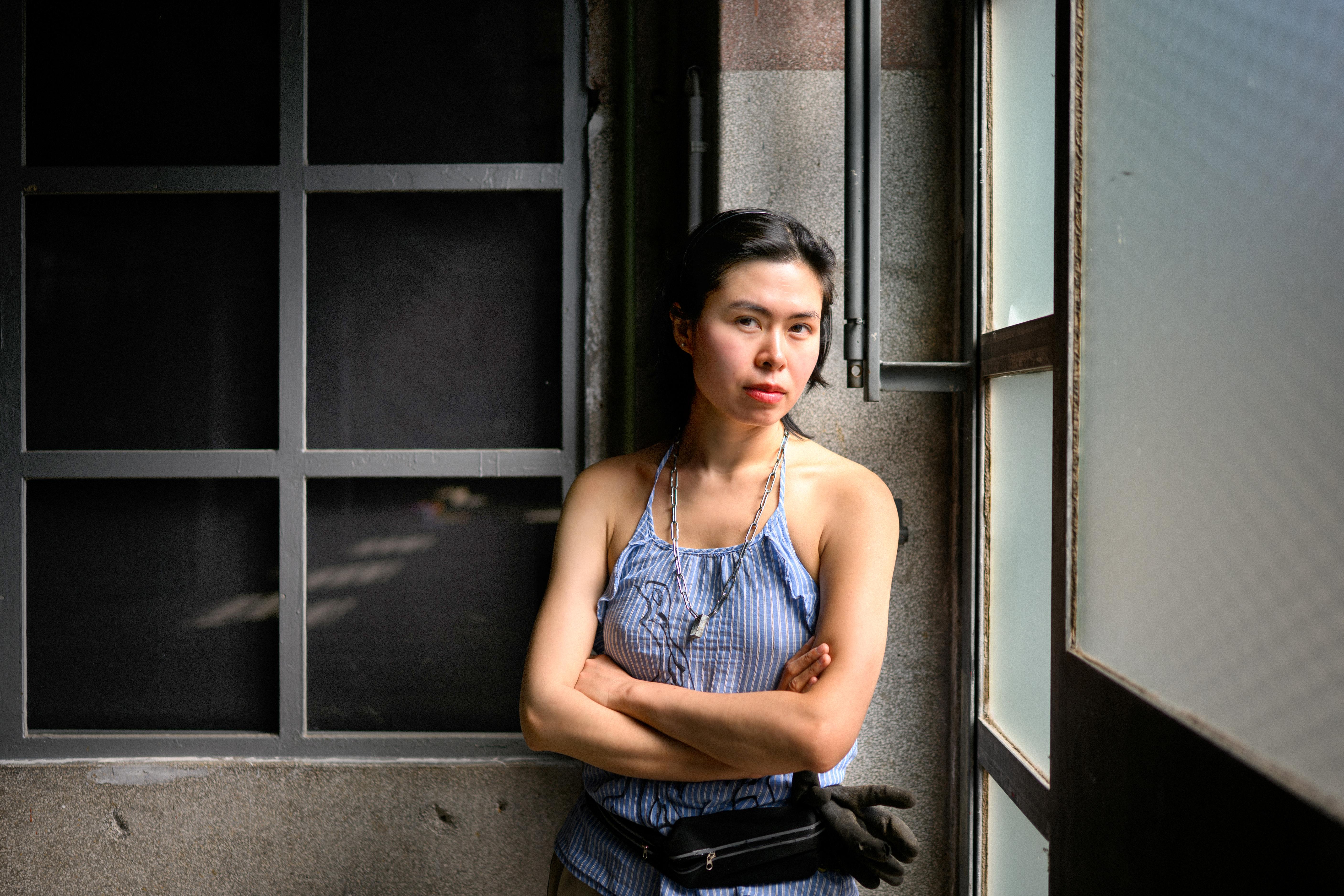
Hiền Hoàng is a Vietnamese German interdisciplinary artist working at the intersection of art, ecology, and material research.
Conversation: Xiaowen Zhu × Hiền Hoàng
Xiaowen Zhu is Director of esea contemporary and an author based between Manchester and Berlin.
Hiền Hoàng is a Vietnamese German interdisciplinary artist working at the intersection of art, ecology, and material research.
Xiaowen Zhu (XZ): Where does the title How to Touch the Elephant come from?
Hiền Hoàng (HH): The title comes from a Vietnamese parable about five blind fortune-tellers who touch an elephant. Each touches a different part of the animal and claims that part represents the whole. One says the elephant is a giant broom; another insists it is a temple pillar. In the end, they fight fiercely, without ever knowing what the elephant looks like.
I use this parable as a metaphor for the trauma of post-Agent Orange landscapes in Vietnam. The damage to the land and to its people is so complex. And yet, despite all the scientific reports and evidence, no court has been able to establish accountability for the ecocide committed during the war: not the 1985 toxic tort lawsuit brought by Vietnam veterans, not the Russell Tribunal of 1966–67, and, sadly, not even the case of Trần Tố Nga, which has been ongoing since 2014.
I think of those landscapes as an elephant, standing there but somehow not seen, or refused recognition. Is it because we are too small to see the whole elephant? Or is it because we refuse to move, like the five blind men, so that even when we touch the landscape, we still cannot see it?
That is where the title comes from: how to touch the elephant, how to touch the landscapes, the trauma, the wounds, the living.
XZ: Your work asks us to think of the landscape not as a backdrop to history, but as a body that carries history. What kinds of knowledge become possible when we begin from the landscape itself?
HH: We tend to map the landscape as the background for life to happen: where trees grow, where animals and humans live. But to look at the landscape as an entity, or a collective of entities, is to acknowledge its capacity to change and grow, as well as its power to bear witness. By that I mean not only its ability to record the traces of events, but also its power to attract, direct, preserve, transform and, moreover, build its own histories. This connects with the thinking of Jane Bennett, Josephine Berry and Susan Schuppli.
That shift changes the kind of knowledge that can emerge: not testimony, but something closer to forensic memory. It is evidence held in sediment, in tree rings, in what grows and what does not. It also changes the position from which we can access that knowledge. I cannot observe a body from a distance and call that understanding. I have to touch it, to let myself become part of it. That is the wager of the piece, and of its title. You do not get to observe the elephant. You have to touch it, and be changed by what you find.
XZ: These are landscapes shaped by war, extraction and ecological damage. What does “ecology” mean when we begin from a damaged or marginalised environment rather than an idealised idea of nature?
HH: I think it means accepting the entanglement of nature, human and other-than-human beings, technology and war. The idealised idea of nature tends to portray it as something untouched by human hands, but that idea is historically false. Western botanists, imperialists and colonists have been surveying, mapping and manipulating the lands they entered since at least the sixteenth century. There was never a pure nature waiting outside that history.
And in the landscapes I work with, this entanglement is not abstract. It is chemical. Dioxin was part of a technology designed specifically to strip vegetation, turning ecology itself into a military strategy. War and ecology are not neighbours here; they are fused together.
So ecology, when it begins from a damaged landscape, cannot mean a state to protect or a baseline to return to. It has to mean something closer to a record: an accumulation of everything that has acted upon that land, including violence, care and refusal. The damaged landscape is not a victim waiting to be restored to some prior purity. It is an entity that has metabolised what was done to it, and continues to metabolise it in the present tense. That is the kind of ecology I want to begin from: not before the damage, but from inside it.
XZ: You move from human relationships and family memory towards soil, water, trees, fungi and other forms of life. Has this changed what you understand by “community”?
HH: Yes, I believe so. It goes hand in hand with the development of my artistic practice. In the beginning, I understood community as something closer to a small circle, made up of people who shared my background or were my relatives. But as I turned my attention towards trees, soil and other forms of life, I began to see how deeply we are connected.
For example, I was researching the migration history of a tree species from East Asia to Europe and the Netherlands. I found that the year the second specimen of that tree was finally planted in Leiden was the same year my aunt in Berlin received her diagnosis of kidney failure. The diagnosis allowed her to stay in Germany after the collapse of the GDR, but it also marked the beginning of an illness that would kill her years later. In one corner of a garden, a tree completed its long migration. In another corner of the world, death and a kind of hope arrived together.
This sense of entanglement grew even stronger through my research. I watched how people in Cần Giờ and southern Vietnam worked to regenerate Rừng Sác, a mangrove forest heavily sprayed with Agent Orange, and how new species took root on ground that death had once touched. I began to understand that community was never only human. It includes the land, the trees, the forest and all the other species that hold it together with us.
Community, for me now, is not a circle I belong to. It is a web I am already inside of.
XZ: Your father’s trauma becomes, in some sense, your own, and then becomes entangled with the trauma of the landscape. Can ecological attention offer another way of understanding or transmitting inherited trauma?
HH: I want to clarify a little how I use the word “trauma” here. The term is deeply rooted in psychology, and much of my reading comes from Cathy Caruth, Freud and Ruth Leys. But in my understanding, ecological trauma differs from psychological trauma primarily in the structure of delay.
In psychological terms, trauma is not fully grasped when it happens; it returns later. Ecological trauma works differently. There is no delay in contact: dioxin binds to soil and tissue the moment it touches them. What is delayed is its manifestation, across seasons and generations. Ecological trauma is closer to a continuous cause with slow, distributed effects, something akin to what Rob Nixon calls “slow violence.”
So when I ask whether ecological attention can offer another way of understanding or transmitting inherited trauma, I think the answer begins here: not by replacing the psychological account, but by giving it a body outside the human one. My father held his trauma in humour and silence. But the landscape holds it differently, in sediment and altered soil. When I trace his trauma into the landscape, I am not looking for a metaphor for what happened to him. I am looking for a second archive.
Ecological attention does not resolve inherited trauma. But it gives it another surface to be read from, one that outlives testimony and the person who first carried it.
XZ: A central concern of Off Centre is what becomes visible when we stay with places outside dominant cultural centres. What has staying with these landscapes allowed you to see, hear or understand that you might not have encountered through more conventional historical or artistic research?
HH: I grew up in Vietnam, where I was taught how we won the war despite our losses. Memorials were everywhere, honouring the people who fought and died, often in generalised and symbolic terms. We won. The war ended. That was how I remembered it.
I do not want to turn away from the sacrifices of those who died. But I began to notice how little the land itself was ever mentioned, how little we spoke of the forests, mountains and rivers we lost. Working on this research gave me another angle from which to look back at the war, only to realise that I am still standing in its shadow. Bomb fragments never left my father’s chest. The war never left the country.
I tried looking at the landscape from several angles: from above, through aerial views of destroyed land; from the ground, where the forest had vanished. But drawing, staying and listening gave me another angle entirely: being submerged in the landscape, touching it and being touched in return. I realised I had become part of its living process, part of the landscape itself.
And the war, even now that I stand in its shadow—or am I still standing inside it?—has left my traces on the land, too. My memory is carried by it now, intertwined with it. And maybe the next generation will pick up these traces and continue to look at the landscape, to touch it, to tell its stories.